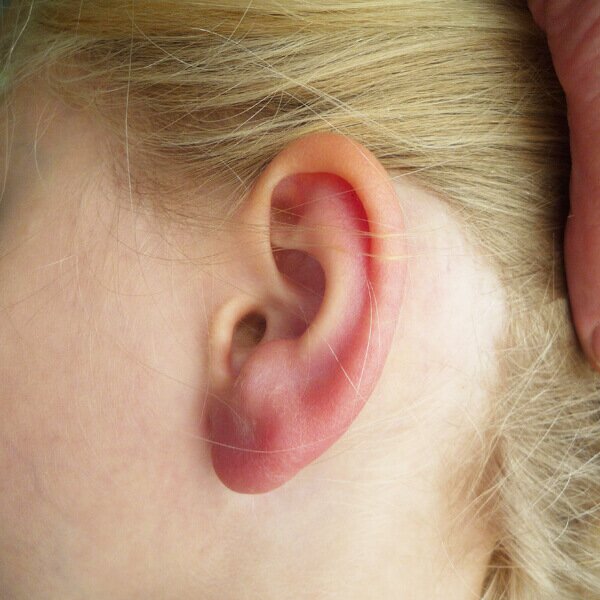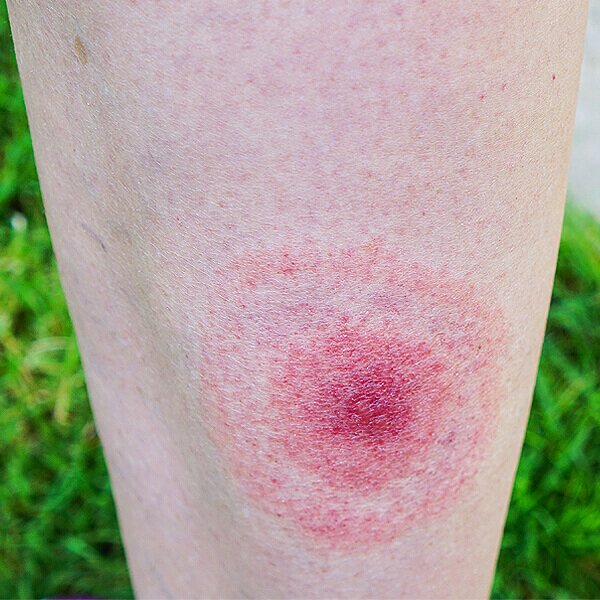


It is not the case that every Lyme patient develops a “wandering flush”; or they may develop one but not notice it due to it appearing over an ‘inaccessible’ body part. With the rise in ‘single’ households where people live without partners, there is no one else to notice e.g. a rash on their back. Also, some patients may not visit the doctor with erythema migrans simply because often it doesn’t hurt or itch. Alternatively, the erythema migrans may not be recognised as such by the patient and/or the doctor and is frequently misdiagnosed as an allergic reaction, insect bite, haematoma or genital mycosis (fungal infection in the genital area).
Furthermore, in practice it can be very difficult to detect an erythema migrans on sun- or solarium-tanned, dark or sunburned skin. This means that these early cases of Lyme disease in stage I (early stage) go undiagnosed and therefore not properly treated. The patient often cures the flu-like stage (stage II) alone at home or it is diagnosed as a viral infection.
We would like to draw your attention to how difficult the practical situation of dealing with Lyme can be. It is undisputed in the medical community that all Lyme disease infections that are not detected in their early stages (early stages I and II) or are not treated properly (treated with fenistil gel, fungicide ointment, cooling, zinc ointment, ‘wait and see’) at least have the potential to change into the chronic form (late stage).